Monday, April 30, 2012

Turkeys, Hawks, and Eggs, Oh My!

I guess I (Lynn) will do a little text for our birding this week.  The story of the week was definitely the Turkeys!  On my way into work one morning a lawn mower chased me down...  He really did, one of the grounds crew wanted to show me something interesting.  He brought me over to a low stone wall and there sitting on top was this egg.

A Turkey egg!! laid directly on a stone wall.

I brought this cell phone picture back to Sue who agreed that it was a turkey egg.  I have seen a female hanging out near this area for a couple of days all by herself.  My guess is that she was a young (1st year) female who hadn't gotten the knack for being a Mom yet. 

Another morning I passed Sue and her sister Karen on my way up to the building and they said that a Red-tailed Hawk was making passes at a couple of turkeys.  By the time I made my way up there the female turkey had walked away a little but these two males near by were still strutting around.

Two Tom Turkeys trying to impress a female (out of sight just now).
When I glance in a tree behind all of this turkey action I caught sight of the hawk... or rather hawks.  Assumably this is a pair of red-tailed Hawks and the male was probably showing off for the female by taking a few swipes at the turkeys earlier.  Here the hawks are taking a rest and bonding.  So, which one is the male and which one is the female.....  you can make a guess using the info below.

Red-tailed Hawk pair, usually seen overhead, but Monday morning found in close proximity to each other, and to us!

"The red-tailed hawk averages 19 to 24 inches in length. There is sexual dimorphism in size: females are 25% larger than the males. Plumage ranges from light auburn to deep brown. The underbelly is distinctly lighter than the rest of the body, with a dark belly band across it. The cere, the soft skin at the base of the beak, the legs, and the feet are all yellow. The eye color of the hawk changes from yellowish gray when immature to dark brown in adults. " -Lake Milton Raptor Center 

Did you guess?  Based on this photo I would say the higher bird is the male although these two are very close in size.  So yes the female is usually larger but everything has variation and this pair is probably made up of a larger than usual male and a smaller than usual female making them relatively close to the same size.  This neighbor below was not too happy to have all this activity so close to his nest!

Northern Mockingbird in a maple.
All photos taken by Lynn!!

West Campus birds for the week of April 16 - 20, 2012:

Wild Turkey
Canada Goose
Mallard
Great Egret
Turkey Vulture
Red-tailed Hawk
Sharp-shinned Hawk
Herring Gull
Ring-billed Gull
10. Killdeer
Mourning Dove
Rock Pigeon
Northern Flicker
Eastern Phoebe
American Crow
Blue Jay
Black-capped Chickadee
House Wren
American Robin
20. European Starling
Northern Mockingbird
Barn Swallow
Tree Swallow
Black-and-white Warbler
Yellow Warbler

Northern Cardinal
White-throated Sparrow
Chipping Sparrow
Savannah Sparrow
30. Song Sparrow
House Finch
American Goldfinch
Red-winged Blackbird
Common Grackle
Brown-headed Cowbird
36. House Sparrow

Friday, April 13, 2012

Special this week - spring plants AND reptiles


Red-tailed Hawk (Buteo jamaicensis) flying "fairly close" overhead. Since the bird-life of West Campus is usually too distant or too active for my little camera, I tend to focus primarily on the nature at my feet.


Marsh Marigold (Caltha palustris) growing in the gravelly river bed at West Campus. Along with the Trout Lily (photo in previous blog post) this yellow-flowering plant is one of the earliest spots of color in the still-brown New England woodlands in April. The sap can be an irritant to sensitive skin.


As I photographed plants along the river's edge, I disturbed a basking Garter Snake (Thamnophis sirtalis). One of the most commonly encountered snakes in New England, this individual shows the typical coloration of buffy-yellow stripes against brown. This is a snake with wide regional color variations, with some subspecies exhibiting bright yellow or even orange stripes against a dark green or black body.

The warming days prompt snakes and turtles to emerge from winter hibernation. If you take time to sit quietly near a wetland or stream, pay attention to every rustle in the leaf litter. Wood turtles (Glyptemys insculpta), water snakes (Nerodia sipedon) and many other reptiles are on the move.


Wild salad - Garlic Mustard (Alliaria petiolata) in front of Wild Onion (Allium sp.)
Allium is the genus of hundreds of species of garlics and onions. Alliaria means "like garlic", referring to the scent of garlic that emanates from the broad-leaved plant when crushed.

Straight from Wikipedia:
Garlic mustard was introduced in North America as a culinary herb in the 1860s and is an invasive species in much of North America. As of 2006, it is listed as a noxious or restricted plant in the US states of Alabama, Connecticut, Massachusetts, Minnesota, New Hampshire, Oregon, Vermont, West Virginia and Washington. Like most invasive plants, once it has an introduction into a new location, it persists and spreads into undisturbed plant communities. In many areas of its introduction in Eastern North America, it has become the dominant under-story species in woodland and flood plain environments, where eradication is difficult.


At West Campus, this plant is particularly vigorous down in the woods along the Oyster River. Each year, Tom Parlapiano gathers volunteers to wage an eradication campaign.

Bird list for the week of April 9-13, 2012 - new migrants in boldface:

Wild Turkey
Osprey
Turkey Vulture
4. Red-tailed Hawk
Herring Gull
Downy Woodpecker
Northern Flicker
8. Rock Pigeon
Mourning Dove
Blue Jay
American Crow
12. European Starling
American Robin
Hermit Thrush
Ruby-crowned Kinglet
16. Tree Swallow
Northern Cardinal
Dark-eyed Junco
Song Sparrow
20. Chipping Sparrow
House Finch
American Goldfinch
Brown-headed Cowbird
24. Common Grackle

Wednesday, April 4, 2012

Nest Box maintenance

Cavity nesters are around, or arriving soon, so we're getting our man-made cavities ready for them. A few weeks ago, Tom Parlapiano made the rounds of the small boxes - the ones we've put up to attract tree swallows, bluebirds, wrens and chickadees. His goal was to clean out old debris - from last years' nests or from overwintering rodents.


Tree Swallow nest box at West Campus, all spruced up for spring.

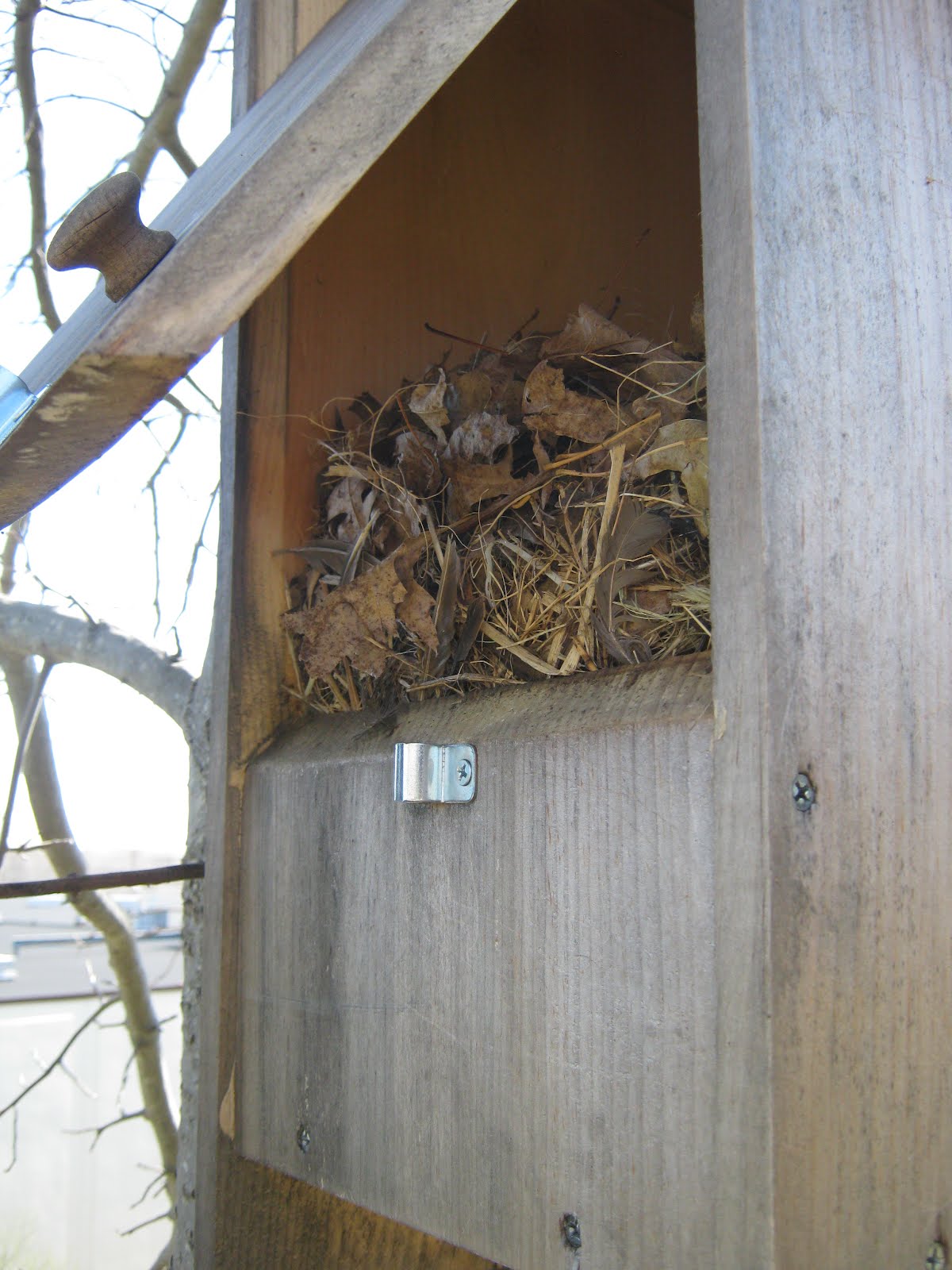
Earlier this week, Lynn and I carried the twelve-foot ladder out to tend to the Kestrel box, and sadly found it quite occupied.
First step is to rap on the box to evict possible rodents. Check, done, nobody came out.
Next step unlatch side panel to see what you have. Check, done, a big pile of leaves and grass. Looks like a rodent nest.
Okay, start to remove the debris, a handful at a time. After three fistfuls of stuff, Lynn stopped, having uncovered a motionless gray squirrel.

Well it was breathing. Why hadn't it run? We guessed perhaps it was a female with newborn pups, so we let her be without disturbing her further. We don't need more squirrels around, but neither did we want to be needlessly cruel -- we should have checked much earlier. Lesson learned.


Our kestrel box is occupied.

Happy to report that we've had a few new birds already this week (writing this on Wednesday, since we have Friday off).
In boldface are birds we haven't seen since last fall
Bird list for the week of April 2-5, 2012:

Canada Goose
Red-tailed Hawk
Sharp-shinned Hawk
Ring-billed Gull
5. Herring Gull
Double-crested Cormorant
Killdeer
Rock Pigeon
Mourning Dove
10. Downy Woodpecker
Northern Flicker
Blue Jay
American Crow
Northern Mockingbird
15. American Robin
Hermit Thrush
European Starling
Black-capped Chickadee
Brown Creeper
20. Golden-crowned Kinglet
Northern Cardinal
Song Sparrow
Dark-eyed Junco
Chipping Sparrow
25. Savannah Sparrow
American Goldfinch
House Finch
Brown-headed Cowbird
Common Grackle
30. Red-winged Blackbird
House Sparrow

Trout lily, Erythronium americanum, photographed at lunchtime today in the nature reserve along the Oyster River. And yes, I did notice the beetle on the flower, but not being familiar with insect groups, I'll leave it at that, a beetle - any suggestions?

Monday, April 2, 2012

Waiting for spring birds


Pollen-bearing catkins of the native North American shrub Salix discolor, otherwise known as Pussywillow.

Bird list for the week of March 26 to March 30, 2012:

Wild Turkey
Turkey Vulture
Black Vulture
Black-capped Chickadee
Brown-headed Cowbird
Blue Jay
Red-tailed Hawk
Ruby-crowned Kinglet
Dark-eyed Junco
Downy Woodpecker
Rock Pigeon
Mourning Dove

Song Sparrow
House Sparrow
House Finch
American Goldfinch
European Starling
American Robin
American Crow
Fish Crow

Northern Cardinal
Northern Flicker
Northern Mockingbird

Killdeer
Osprey


Northern Mockingbird, Mimus polyglottos, the many-tongued mimic. Here sunning quietly on pavement in the early morning.

Did anybody notice what I was attempting with the bird names? Emphasize "attempting". Okay, it really only worked for the first few names of the first two groups...

Friday, March 23, 2012

What else, but S-p-r-i-n-g ! !

Mid-week we passed the vernal equinox.
All week we had warmer than normal temperatures in Connecticut (70's).
Last week the Eastern Phoebes returned in great numbers - hooray!
The evening chorusing of Spring peepers is hard to miss.
Jupiter, Venus, Mars and Sirius are all shining brightly in a stretch of clear moonless nights.

And we have another two-week bird list to report. But, weekly listing will begin soon, as more and more migrants pass through our greening hilltop at West Campus.

Bird list for the two week period from March 12th through 23rd, 2012:

White-breasted Nuthatch
Tufted Titmouse
Black-capped Chickadee
4. Carolina Wren

Eastern Phoebe
House Finch
7. American Goldfinch

American Robin
Northern Mockingbird
Cedar Waxwing
European Starling
12. House Sparrow

Northern Cardinal
White-throated Sparrow
Song Sparrow
16. Dark-eyed Junco

Red-winged Blackbird
Common Grackle
19. Brown-headed Cowbird

Mourning Dove
Rock Pigeon
Downy Woodpecker
Hairy Woodpecker
24. Northern Flicker

Blue Jay
American Crow
Fish Crow
28. Northern Raven

Turkey Vulture
Red-tailed Hawk
Sharp-shinned Hawk
32. Osprey

Killdeer
Great Black-backed Gull
Herring Gull
Ring-billed Gull
Canada Goose
38. Wild Turkey


West Campus Coyote, Canis latrans, photo L.Jones

Of course we always have an eye open for other denizens of our hilltop and stream valley. This pale coyote still sports its winter coat and has lost a few pounds during the lean season. And Lynn points out that it has lost something else as well...

Submissions to the bird list for the past two weeks have come from Tom Parlapiano's 3rd grade field trip, from Nate (his excellent sighting of the Sharp-shinned Hawk in the courtyard), mostly from Lynn Jones and a few additions from yours truly.

--have a good weekend, and I probably don't have to tell YOU to get out and enjoy these days!
Sue Hochgraf

Friday, March 9, 2012

And Robins are back!!


American Robin, Turdus migratorius
Lynn's photo

What's not to be happy about? A big wave of migrating birds has come in with the recent south winds and warm weather. On campus we've seen lots and lots of robins these past two weeks. Elsewhere in the state, folks on the coast are monitoring the plankton blooms to get ready for the gulls which follow. Large blackbird flocks are noticeable even to the casual observer driving along the interstates. One late afternoon I watched many small skeins of Canada Geese moving northward.

Yesterday evening at home I heard two American Woodcock calling - "peenting" as birders hear it, followed shortly by the whistling sound made as the bird spirals back to the earth. These sounds are part of their early spring mating display. The males will call from a small patch of open ground then take off skyward, flying so high they're almost lost to our sight. Then they perform a sort of spiralling freefall back to their patch of turf, air rushing past specially modified wing feathers to make the whistling sound that we hear.

Watch for Red-tailed Hawks performing their dramatic aerial duets. Watch for the first moth, the first butterfly on the first dandelion, the first salamander crossing the road on a warm rainy night.

The return of spring still thrills this Homo sapiens, who lives in a world where so many people seem to shut out the natural world.
No way, I say hooray for spring - let's all go out and get MUDDY!!

West Campus bird list for the two week period from February 27th through today, March 9th, 2012:

Wild Turkey
Canada Goose
Killdeer
Ring-billed Gull
Herring Gull
Great Black-backed Gull
Red-tailed Hawk
Mourning Dove
Rock Pigeon
10. Downy Woodpecker
Northern Flicker
American Crow
Fish Crow
Bluejay
American Robin
Northern Mockingbird
Black-capped Chickadee
Carolina Wren
European Starling
20. Northern Cardinal
White-throated Sparrow
Song Sparrow
American Goldfinch
House Finch
Red-winged Blackbird
Common Grackle
27. House Sparrow

Friday, February 24, 2012

Blackbirds arrived this week!

Basically an unseasonably warm stretch, but overnight last night (23rd-24th) it snowed. Just an inch or two, then changed to fine rain, and now, at the end of the afternoon, the temperature is still low enough that the snow lingers.


One of our local Red-tailed Hawks, Buteo jamaicensis.
Lynn's photo.

Birds for the two week period from February 13-17 and 20-24th, 2012.

Wild Turkey
Canada Goose
Herring Gull
Ring-billed Gull
Turkey Vulture
Red-tailed Hawk - a kettle of seven birds, a mix of five "tails" and two
Cooper's Hawk (probably) - which did NOT include our two local Red-tails
Mourning Dove
Downy Woodpecker
10. Northern Flicker

American Crow
Fish Crow
Blue Jay
Black-capped Chickadee
Carolina Wren
Northern Mockingbird
American Robin
European Starling
Northern Cardinal
20. Song Sparrow


An old familiar tune is back on campus - the Song Sparrows are singing!
Lynn's photo. Melospiza melodia melodia

House Finch
American Goldfinch
Red-winged Blackbird
Common Grackle
Brown-headed Cowbird
26. House Sparrow

Friday, February 3, 2012

Just the regulars...

Red-tailed Hawk, Buteo jamaicensis, photo Lynn Jones

The "tails" have been more noticeable these last two weeks. Three were seen more-or-less together one morning over West Campus. Lynn recently photographed this beautiful dark adult.

No snow cover, night-time temperatures in the twenties, daytime temps in the forties - this seems more like mid-March than February. The birds are usually around our feeders when it's particularly cold, or when a storm is threatening, but with the milder temperatures, they've been rather scarce.

Still we've managed a two-week list of twenty three species.

Birds seen at West Campus between January 30th and February 10th, 2012:

Wild Turkey
Canada Goose
Ring-billed Gull
Herring Gull
Turkey Vulture


Lynn caught this male Wild Turkey displaying yesterday.

Red-tailed Hawk
Mourning Dove
Rock Pigeon
Downy Woodpecker
Red-bellied Woodpecker

American Crow
Fish Crow
Blue Jay
American Robin
Northern Mockingbird

European Starling
Black-capped Chickadee
Carolina Wren
Northern Cardinal
White-throated Sparrow

House Finch
American Goldfinch
House Sparrow


same handsome fellow as above, now you can appreciate the detail

Monday, January 23, 2012

January 2012

We've been birding and blogging at West Campus for two and a half years now, compiling quite a list of bird species, and documenting seasonal changes in the process. Occasionally we submit a list to e-bird, a website developed by Cornell University for the purpose of collecting and sharing data on bird sightings. (see end of blog post)

Usually when we contribute a list to e-bird it's because we've either seen something "good" that we want to share, or because we've done a thorough survey, such as the Christmas Count or a hawk watch. Advocates of e-bird would like us birders to get in the habit of submitting ALL of our birding efforts, to better document year-round bird activity in our favored "hot-spots".

Although we understand the reasons, we don't necessarily always have the time. Ultimately e-bird is happy to get whatever data we citizen scientists are willing to volunteer. As an end-user of e-bird data I certainly appreciate a plethora of birding reports. For example, over the semester break I was birding in Florida, and was able to check the reports of other e-birders to plan my stops.

I checked for species, such as the Florida Scrub-Jay (Florida's only endemic bird), and the Red-cockaded Woodpecker (a vulnerable species). Searches can also be made by specific location, such as Sanibel Island or the Anhinga Trail within Everglades National Park. Ultimately, e-bird is just one of many tools a birder can use to find good places to go birding.


We finally have some snow cover, and look what shows up...

I haven't posted our list here on the blog in over a month - feeder activity has been s-l-o-w, but I'll list the birds we've seen since the start of the new year. Many of these birds are using our assorted feeding stations, placed in the courtyard where we can observe. I'll just write "feeder" after these species.

West Campus bird list for the first three weeks of 2012:

1. Wild Turkey - feeder
Canada Goose
Turkey Vulture
Red-tailed Hawk
5. Merlin
Ring-billed Gull
Herring Gull
Mourning Dove - feeder
Rock Pigeon
10. Downy Woodpecker - feeder
Red-bellied Woodpecker - feeder
Blue Jay - feeder
American Crow
European Starling
15. Black-capped Chickadee - feeder
Carolina Wren
American Robin
Northern Cardinal - feeder
Dark-eyed Junco - feeder
20. Song Sparrow - feeder
White-throated Sparrow - feeder
Fox Sparrow - feeder
American Goldfinch
House Finch - feeder
25. House Sparrow - feeder

Here's a link to e-bird. http://ebird.org/content/ebird/ You'll see there's a lot to explore, and Cornell continues to improve the user interface as well as the data-generating possibilities.

Monday, December 19, 2011

112th Annual Christmas Bird Count

The year 2011 is the 112th CBC, the first official Christmas Bird Count was in the year 1900. There's a pretty long run of citizen science for you.

As we have for over a decade, Tom, Lynn and I each participated in our own regional counts on Saturday, which meant West Campus was not counted that day. Instead we counted here today, and by the official rules we cannot add numbers, only species to the official tally - and only if it's a species that was not found in the New Haven circle on Saturday.

Two years ago our Barred Owl was added as one of these "count week" species. Today we weren't able to add any new species, but put in a good birding effort anyway.

Here are the results:

number in party: 3 (Lynn, me, Tom)
party hours: 7 (6:45 to 2:15 with a lunch break)
weather conditions: cold 20-28F, clear and calm in the early morning, partly cloudy and breezy through the mid-day.
no snow, moving water was open, still water with thin ice
number of species: 34
number of individual birds: 454

31 Canada Goose
1 Mute Swan
5 Wild Turkey
1 Turkey Vulture
4 Red-tailed Hawk

75 Ring-billed Gull
20 Herring Gull
30 Rock Pigeon
10 Mourning Dove
3 Red-bellied Woodpecker

6 Downy Woodpecker
1 Northern Flicker
7 Blue Jay
40 American Crow
1 Fish Crow

8 Black-capped Chickadee
1 Tufted Titmouse
2 White-breasted Nuthatch
2 Carolina Wren
3 Ruby-crowned Kinglet

1 Hermit Thrush
50 American Robin
1 Gray Catbird
2 Northern Mockingbird
43 European Starling

9 Song Sparrow
1 Swamp Sparrow
14 White-throated Sparrow
1 White-crowned Sparrow
2 Dark-eyed Junco

14 Northern Cardinal
45 House Finch
10 American Goldfinch
20 House Sparrow

An excellent birding effort - beats our 2009 number by one, and the 2010 number by several - but last year's search was hampered by two feet of snow on the ground!

2010 results here
2009 results here