Friday, June 29, 2012

Breeding Birds

June is definitely all about breeding birds.  As Lynn mentioned earlier, most species we see with their "feet on the ground" here are breeding birds.  The campus grounds has abundant habitat for those birds adapted to suburban survival - with shrubs, lawns, mature trees and some wild and weedy areas being our prevalent habitat types.

I'm always surprised when I find our Wood Thrush still singing away on its territory - a small patch of hardwoods with a fairly open forest floor and adjacent dense tangles of invasive vines and shrubs.  Recent research on the habitat needs of this species indicates that although it is a fairly common breeder in small forest fragments such as ours, its breeding success rate is higher when it occupies larger forested areas.

Above, one of the pups from our coyote family - a typical coyote sighting for most Connecticut residents.
And here's a different pup from the family, taking the sun about 3 meters from a parking area - a typical coyote sighting for us at West Campus
With Mama Coyote and four pups around, it's no wonder we see very little of our turkey flock these days, and the resident Red-tailed Hawks are actively hunting on campus, making the squirrels, chipmunks and rabbits not as visible as they sometimes are.

So, Lynn and I both had time to get out birding this week, and here's the result of our modest effort:
Bird list for the week of June 25-29, 2012:
Herring Gull
Killdeer
Red-tailed Hawk
Osprey
Rock Pigeon
Mourning Dove
Northern Flicker
Blue Jay
European Starling
10. American Robin
Wood Thrush
Warbling Vireo
Red-eyed Vireo
Gray Catbird
Northern Mockingbird
Yellow Warbler
Common Yellowthroat
Barn Swallow
Northern Rough-winged Swallow
20. Cedar Waxwing
House Wren
Black-capped Chickadee
Tufted Titmouse
Northern Cardinal
Song Sparrow
Chipping Sparrow
American Goldfinch
Common Grackle
Brown-headed Cowbird
30. House Sparrow

Tuesday, June 26, 2012

Back to Birds

After months of planning, the 27th annual meeting of the Society for the Preservation of Natural History Collections finally took place at the Omni Hotel in New Haven, CT.  The Yale Peabody Museum of Natural History was the host this year and much of our collections staff was involved in the planning and hosting of this amazing event.  It went off great!  Now that it's over.... we can finally get back to the birds.

Sue and I have had almost no time for lunch time walks or keeping our bird board up to date.  The first thing we did on Tuesday morning (after the meeting), was wipe down the birds to start over fresh.  The weather's been jumping around with a heat wave of 3 consecutive days over 90 degrees (that's what a heat wave technically is) to overnight lows last night of somewhere near 60.  Everyone on campus at this time of year are likely breeders.  Of course some are just passing over.

Great Egret
Red-tailed Hawk
Turkey Vulture
Killdeer
Herring Gull
Common Flicker
Mourning Dove
Blue Jay
Barn Swallow
House Wren
Northern Mockingbird
Gray Catbird
American Robin
Yellow Warbler
Cedar Waxwing
Tufted Titmouse
European Starling
Song Sparrow
Chipping Sparrow
Northern Cardinal
American Goldfinch
House Finch
House Sparrow
Common Grackle

Baby Robin- photo by Lynn Jones

24 species total for one week.  Gray Catbirds have been seen flying into the Pussy Willow bushes to pluck off some berries and then fly back to their hidden nests and young.  Baby American Robins have been spotted all around campus waiting for their parents to bring them snacks. 


Monday, May 21, 2012

Weekly species tally

Bird list for the week of May 14-18, 2012
Mourning Dove
House Finch
Downy Woodpecker
etc
etc
Here's how we keep our weekly tallies at West Campus:

Panel 1
Panel 1 - top, middle and bottom
The bird names stay in place on these glass panels and we mark the day of the week when seen.  Panel one (shown in the three images above) is the regulars, those we're likely to see nearly every day.  We shift to the second panel as more species move through West Campus, and add names in the order of occurrence.  When winter is over, we remove strictly winter birds from the first panel and fill in those gaps with spring and summer birds.

Panel 2

Panel 2, top, middle and bottom
 The second panel, shown in the above three images, is a mix from common year-round species (Rock Pigeon) to early spring migrants (Barn Swallow).  Some of the spring species just pass through on migration and are not seen again until fall, so these will be removed from the list in a few weeks time, when the likelihood of seeing them diminishes.

Panel 3
  
Panel 3, top, middle and bottom
As we fill the second panel, we round the corner to the last panel (above three images) which shows only the most recent arrivals - including our first of the year Blackpoll Warbler.

The records I keep here on the blog do not include these daily observations, so these data are lost.  However, the weekly tallies reflect the frequency and duration of our birding outings, inasmuchas we have to be in the right place at the right time.  If we don't get out much, we don't see the birds.  The Blackpoll Warbler might have been out there on Wednesday - and Friday too, but Thursday was the day Lynn was there and saw the bird - so it goes on the list for the week.

Monday, May 14, 2012

Birds birds birds and...

West Campus bird list for the week of May 7-11, 2012

Boldface are all migrants, arriving between say, March and May.  In blue are two new migrants for the week.

Blackbird, Red-winged
Cardinal, Northern
Catbird, Gray
Cormorant, Double-crested
Cowbird, Brown-headed
Crow, American
Dove, Mourning
Finch, House
Flicker, Northern
Goldfinch, American
Grackle, Common
Gull, Herring
Hawk, Red-tailed
Jay, Blue
Mallard
Mockingbird, Northern
Oriole, Baltimore
Osprey
Pigeon, Rock
Robin, American
Sparrow, House
Sparrow, Savannah
Sparrow, Song
Starling, European
Swallow, Barn
Thrush, Wood 
Turkey, Wild
Vireo, Red-eyed
Vireo, Warbling
Warbler, Yellow
Waxwing, Cedar
Woodpecker, Red-bellied
Wren, House
Yellowthroat, Common


And here's the "birds birds birds and..." part.
The white squirrel was sighted again this week!!   It overwintered near the education building at West Campus, in a leafy drey, possibly in company with a regular gray squirrel - of course beneath that white pelage, our white squirrel is a regular Sciurus carolinensis, Eastern Gray Squirrel, anyway.
Link to enjoy photos of albino Eastern Gray Squirrels.
Link to learn how to distinguish albino from  white form gray squirrels.

ps - ours is a true albino

Monday, May 7, 2012

Spring Migrants REALLY arrived this week


Black-and-white Warbler, Mniotilta varia, photo www.avesinart.com
Bird list for the week of April 30 through May 4, 2012:
 
Wild Turkey
Canada Goose

oh forget that -- let's just jump right into the warblers!! Boldface species are ALL new for the year.

Yellow Warbler
Black-and-white Warbler
Yellow-rumped Warbler
Nashville Warbler - Vermivora ruficapilla - new species for West Campus.  First addition in over seven months!
Black-throated Green Warbler
Magnolia Warbler
Common Yellowthroat
10. Blue-winged Warbler
Ovenbird


Blue-headed Vireo
Warbling Vireo
Rose-breasted Grosbeak
Great Crested Flycatcher
Indigo Bunting
Wood Thrush
Chimney Swift
Ruby-throated Hummingbird
20. Gray Catbird
White-crowned Sparrow
Blue-headed Vireo, Vireo solitarius, photo www.avesinart.com
Cedar Waxwing
Barn Swallow
Tree Swallow
Eastern Phoebe

House Wren
Carolina Wren
Ruby-crowned Kinglet
Black-capped Chickadee
30. Tufted Titmouse

Savannah Sparrow
Chipping Sparrow
Song Sparrow
White-throated Sparrow

American Goldfinch
House Finch
Northern Cardinal
Blue Jay
American Crow
40. Fish Crow

American Robin
European Starling
Northern Mockingbird

Gray Catbird, Dumetella carolinensis, photo www.avesinart.com
Double-crested Cormorant
Mallard
Red-tailed Hawk
Osprey
Turkey Vulture
Herring Gull
50. Killdeer

Downy Woodpecker
Northern Flicker
Mourning Dove
Rock Pigeon

Red-winged Blackbird
Common Grackle
Brown-headed Cowbird
58. House Sparrow
Wow, we just blew past our previous high weekly count of 52 species, from September 2011.

Friday, May 4, 2012

Abundance of birds - hooray!

Bird list for the week of April 23-27, 2012:

Wild Turkey
Double-crested Cormorant
Canada Goose
Mallard
Red-tailed Hawk
Herring Gull
Great Black-backed Gull
Killdeer
Mourning Dove
Rock Pigeon

Northern Flicker
American Crow
Blue Jay
European Starling
American Robin
House Wren
Carolina Wren
Black-capped Chickadee
Northern Mockingbird
Barn Swallow

Northern Rough-winged Swallow
Yellow Warbler
Northern Cardinal
Song Sparrow
White-throated Sparrow
Chipping Sparrow
Savannah Sparrow
Dark-eyed Junco
Red-winged Blackbird
Common Grackle

Brown-headed Cowbird
American Goldfinch
House Finch
House Sparrow

Monday, April 30, 2012

Turkeys, Hawks, and Eggs, Oh My!

I guess I (Lynn) will do a little text for our birding this week.  The story of the week was definitely the Turkeys!  On my way into work one morning a lawn mower chased me down...  He really did, one of the grounds crew wanted to show me something interesting.  He brought me over to a low stone wall and there sitting on top was this egg.

A Turkey egg!! laid directly on a stone wall.

I brought this cell phone picture back to Sue who agreed that it was a turkey egg.  I have seen a female hanging out near this area for a couple of days all by herself.  My guess is that she was a young (1st year) female who hadn't gotten the knack for being a Mom yet. 

Another morning I passed Sue and her sister Karen on my way up to the building and they said that a Red-tailed Hawk was making passes at a couple of turkeys.  By the time I made my way up there the female turkey had walked away a little but these two males near by were still strutting around.

Two Tom Turkeys trying to impress a female (out of sight just now).
When I glance in a tree behind all of this turkey action I caught sight of the hawk... or rather hawks.  Assumably this is a pair of red-tailed Hawks and the male was probably showing off for the female by taking a few swipes at the turkeys earlier.  Here the hawks are taking a rest and bonding.  So, which one is the male and which one is the female.....  you can make a guess using the info below.

Red-tailed Hawk pair, usually seen overhead, but Monday morning found in close proximity to each other, and to us!

"The red-tailed hawk averages 19 to 24 inches in length. There is sexual dimorphism in size: females are 25% larger than the males. Plumage ranges from light auburn to deep brown. The underbelly is distinctly lighter than the rest of the body, with a dark belly band across it. The cere, the soft skin at the base of the beak, the legs, and the feet are all yellow. The eye color of the hawk changes from yellowish gray when immature to dark brown in adults. " -Lake Milton Raptor Center 

Did you guess?  Based on this photo I would say the higher bird is the male although these two are very close in size.  So yes the female is usually larger but everything has variation and this pair is probably made up of a larger than usual male and a smaller than usual female making them relatively close to the same size.  This neighbor below was not too happy to have all this activity so close to his nest!

Northern Mockingbird in a maple.
All photos taken by Lynn!!

West Campus birds for the week of April 16 - 20, 2012:

Wild Turkey
Canada Goose
Mallard
Great Egret
Turkey Vulture
Red-tailed Hawk
Sharp-shinned Hawk
Herring Gull
Ring-billed Gull
10. Killdeer
Mourning Dove
Rock Pigeon
Northern Flicker
Eastern Phoebe
American Crow
Blue Jay
Black-capped Chickadee
House Wren
American Robin
20. European Starling
Northern Mockingbird
Barn Swallow
Tree Swallow
Black-and-white Warbler
Yellow Warbler

Northern Cardinal
White-throated Sparrow
Chipping Sparrow
Savannah Sparrow
30. Song Sparrow
House Finch
American Goldfinch
Red-winged Blackbird
Common Grackle
Brown-headed Cowbird
36. House Sparrow

Friday, April 13, 2012

Special this week - spring plants AND reptiles


Red-tailed Hawk (Buteo jamaicensis) flying "fairly close" overhead. Since the bird-life of West Campus is usually too distant or too active for my little camera, I tend to focus primarily on the nature at my feet.


Marsh Marigold (Caltha palustris) growing in the gravelly river bed at West Campus. Along with the Trout Lily (photo in previous blog post) this yellow-flowering plant is one of the earliest spots of color in the still-brown New England woodlands in April. The sap can be an irritant to sensitive skin.


As I photographed plants along the river's edge, I disturbed a basking Garter Snake (Thamnophis sirtalis). One of the most commonly encountered snakes in New England, this individual shows the typical coloration of buffy-yellow stripes against brown. This is a snake with wide regional color variations, with some subspecies exhibiting bright yellow or even orange stripes against a dark green or black body.

The warming days prompt snakes and turtles to emerge from winter hibernation. If you take time to sit quietly near a wetland or stream, pay attention to every rustle in the leaf litter. Wood turtles (Glyptemys insculpta), water snakes (Nerodia sipedon) and many other reptiles are on the move.


Wild salad - Garlic Mustard (Alliaria petiolata) in front of Wild Onion (Allium sp.)
Allium is the genus of hundreds of species of garlics and onions. Alliaria means "like garlic", referring to the scent of garlic that emanates from the broad-leaved plant when crushed.

Straight from Wikipedia:
Garlic mustard was introduced in North America as a culinary herb in the 1860s and is an invasive species in much of North America. As of 2006, it is listed as a noxious or restricted plant in the US states of Alabama, Connecticut, Massachusetts, Minnesota, New Hampshire, Oregon, Vermont, West Virginia and Washington. Like most invasive plants, once it has an introduction into a new location, it persists and spreads into undisturbed plant communities. In many areas of its introduction in Eastern North America, it has become the dominant under-story species in woodland and flood plain environments, where eradication is difficult.


At West Campus, this plant is particularly vigorous down in the woods along the Oyster River. Each year, Tom Parlapiano gathers volunteers to wage an eradication campaign.

Bird list for the week of April 9-13, 2012 - new migrants in boldface:

Wild Turkey
Osprey
Turkey Vulture
4. Red-tailed Hawk
Herring Gull
Downy Woodpecker
Northern Flicker
8. Rock Pigeon
Mourning Dove
Blue Jay
American Crow
12. European Starling
American Robin
Hermit Thrush
Ruby-crowned Kinglet
16. Tree Swallow
Northern Cardinal
Dark-eyed Junco
Song Sparrow
20. Chipping Sparrow
House Finch
American Goldfinch
Brown-headed Cowbird
24. Common Grackle

Wednesday, April 4, 2012

Nest Box maintenance

Cavity nesters are around, or arriving soon, so we're getting our man-made cavities ready for them. A few weeks ago, Tom Parlapiano made the rounds of the small boxes - the ones we've put up to attract tree swallows, bluebirds, wrens and chickadees. His goal was to clean out old debris - from last years' nests or from overwintering rodents.


Tree Swallow nest box at West Campus, all spruced up for spring.

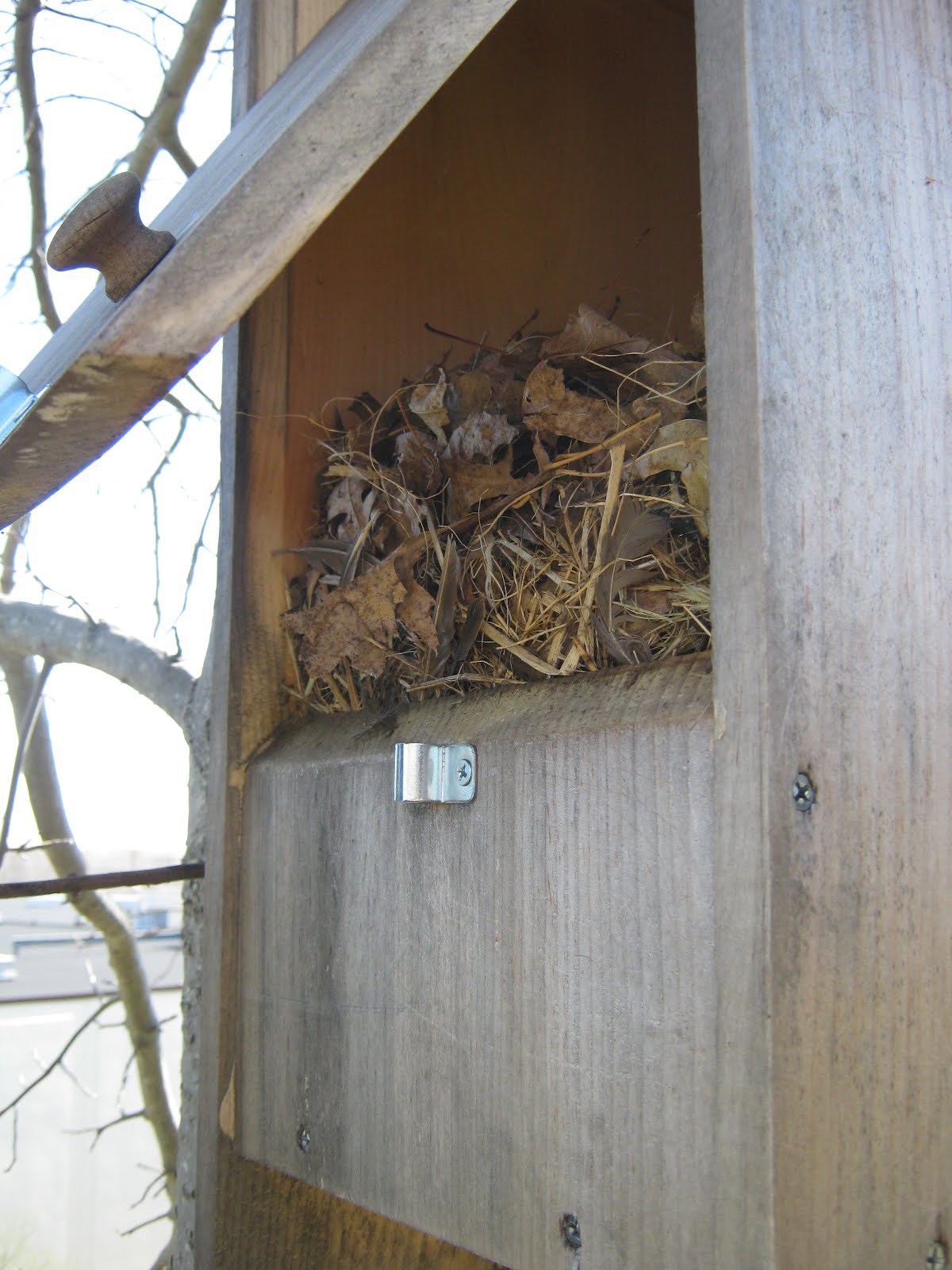
Earlier this week, Lynn and I carried the twelve-foot ladder out to tend to the Kestrel box, and sadly found it quite occupied.
First step is to rap on the box to evict possible rodents. Check, done, nobody came out.
Next step unlatch side panel to see what you have. Check, done, a big pile of leaves and grass. Looks like a rodent nest.
Okay, start to remove the debris, a handful at a time. After three fistfuls of stuff, Lynn stopped, having uncovered a motionless gray squirrel.

Well it was breathing. Why hadn't it run? We guessed perhaps it was a female with newborn pups, so we let her be without disturbing her further. We don't need more squirrels around, but neither did we want to be needlessly cruel -- we should have checked much earlier. Lesson learned.


Our kestrel box is occupied.

Happy to report that we've had a few new birds already this week (writing this on Wednesday, since we have Friday off).
In boldface are birds we haven't seen since last fall
Bird list for the week of April 2-5, 2012:

Canada Goose
Red-tailed Hawk
Sharp-shinned Hawk
Ring-billed Gull
5. Herring Gull
Double-crested Cormorant
Killdeer
Rock Pigeon
Mourning Dove
10. Downy Woodpecker
Northern Flicker
Blue Jay
American Crow
Northern Mockingbird
15. American Robin
Hermit Thrush
European Starling
Black-capped Chickadee
Brown Creeper
20. Golden-crowned Kinglet
Northern Cardinal
Song Sparrow
Dark-eyed Junco
Chipping Sparrow
25. Savannah Sparrow
American Goldfinch
House Finch
Brown-headed Cowbird
Common Grackle
30. Red-winged Blackbird
House Sparrow

Trout lily, Erythronium americanum, photographed at lunchtime today in the nature reserve along the Oyster River. And yes, I did notice the beetle on the flower, but not being familiar with insect groups, I'll leave it at that, a beetle - any suggestions?

Monday, April 2, 2012

Waiting for spring birds


Pollen-bearing catkins of the native North American shrub Salix discolor, otherwise known as Pussywillow.

Bird list for the week of March 26 to March 30, 2012:

Wild Turkey
Turkey Vulture
Black Vulture
Black-capped Chickadee
Brown-headed Cowbird
Blue Jay
Red-tailed Hawk
Ruby-crowned Kinglet
Dark-eyed Junco
Downy Woodpecker
Rock Pigeon
Mourning Dove

Song Sparrow
House Sparrow
House Finch
American Goldfinch
European Starling
American Robin
American Crow
Fish Crow

Northern Cardinal
Northern Flicker
Northern Mockingbird

Killdeer
Osprey


Northern Mockingbird, Mimus polyglottos, the many-tongued mimic. Here sunning quietly on pavement in the early morning.

Did anybody notice what I was attempting with the bird names? Emphasize "attempting". Okay, it really only worked for the first few names of the first two groups...